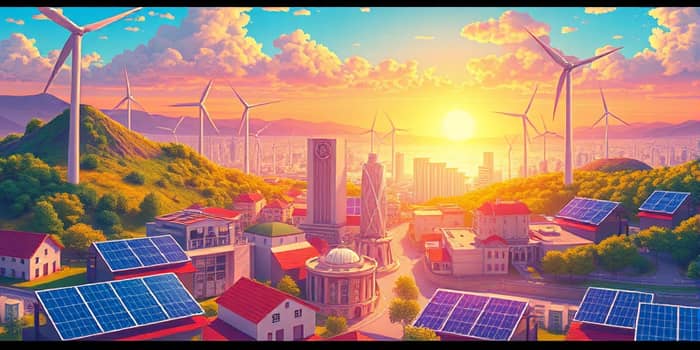
The world stands at a crossroads where environmental responsibility meets unprecedented economic opportunity.
Global investments in energy soared to over $3.3 trillion in 2025, signaling a seismic shift toward sustainability.
This momentum is driven by the urgent need to combat climate change and harness the financial potential of clean technologies.
Now is the time to understand how investing in renewables can transform our future.
The Global Surge in Clean Energy Investments
In recent years, the energy sector has witnessed a dramatic reallocation of capital.
Two-thirds of total investments, amounting to $2.2 trillion, are now channeled into clean technologies.
This includes renewables, electric vehicles, smart grids, and storage solutions.
BloombergNEF projects that the transition requires annual investments scaling to more than $4 trillion in the coming decades.
Such funding is essential to meet global climate targets and drive innovation.
Renewable capacity is set to multiply by 2.7 before 2030, with solar and wind leading the charge.
This growth is not just about saving the planet; it's about securing economic resilience and energy independence.
Spain's Leadership in the Renewable Revolution
Spain has emerged as a European powerhouse in renewable energy.
From a modest 20 GW in 2008, the country now boasts over 80 GW of installed capacity by 2025.
Solar photovoltaic energy alone accounts for 32 GW, representing more than 20% of the total system capacity.
Wind power follows closely with 31 GW, showcasing a balanced and robust energy mix.
The National Integrated Energy and Climate Plan (PNIEC) aims to reach 76 GW of solar by 2030.
This ambition is supported by key trends for 2026, including solar growth, wind repowering, and green hydrogen development.
Electric vehicle infrastructure is expanding, with nearly 50,000 public charging points, though regional disparities persist.
Biomethane could cover 40% of national gas demand, highlighting the diversity of clean solutions.
Major players like EDP are committing billions, with plans for around €12 billion in investments from 2026 to 2028.
Unlocking Economic Potential and Job Creation
Investing in renewables offers substantial economic benefits beyond environmental gains.
Spain needs to mobilize €241 billion for its energy transition, with 80% from private sources.
This effort could boost GDP by 1.8% and generate up to 348,000 new jobs across various sectors.
Globally, the renewable sector already supports 11.5 million jobs, a number set to rise.
Key economic advantages include:
- Increased GDP growth through infrastructure development.
- Job creation in installation, maintenance, and technology innovation.
- Reduced energy import bills, saving billions annually.
- Enhanced energy security and price stability for consumers.
The levelized cost of electricity for solar has dropped by 80% since 2010, making it highly competitive.
This financial viability attracts investors seeking long-term returns while contributing to a greener economy.
Key Technologies Driving the Transition
The clean energy landscape is powered by a suite of innovative technologies.
Each plays a critical role in decarbonizing industries and enhancing efficiency.
Notable technologies include:
- Solar photovoltaic systems, with rapid deployment and falling costs.
- Wind energy, both onshore and emerging offshore projects.
- Green hydrogen, projected to grow sixfold by 2050 for industrial use.
- Energy storage solutions to manage variability and ensure grid stability.
- Smart grids and digitalization for optimized energy distribution.
- Biomethane as a renewable alternative to natural gas.
- Electric vehicles supported by expanding charging networks.
These technologies are interconnected, enabling a holistic approach to energy transformation.
Investors should focus on areas with high growth potential and regulatory support.
Challenges and Solutions for 2026 and Beyond
Despite progress, significant hurdles must be addressed to sustain momentum.
2026 is poised as a pivotal year with new regulations and infrastructure demands.
Key challenges include:
- Grid saturation hindering the connection of authorized renewable capacity.
- Need for advanced storage and smart grid technologies to manage variability.
- Regulatory gaps in traceability for biomethane and hydrogen.
- Uneven deployment of electric vehicle charging infrastructure.
- Ensuring supply chain stability and material availability for rapid scaling.
Solutions involve doubling investments in grid networks and fostering public-private collaboration.
Digitalization and innovative financing models are essential to overcome these barriers.
By proactively addressing these issues, stakeholders can unlock the full potential of clean energy investments.
Investment Opportunities and Emerging Trends
The shift toward renewables presents lucrative opportunities for investors and businesses.
European demand for investments is strong, driven by lower interest rates and rising electricity needs.
Trends to watch include:
- Hybridization of solar and wind projects for optimized output.
- Expansion of smart grids and energy efficiency measures.
- Growth in green hydrogen and biomethane sectors.
- Increased focus on energy resilience and affordability over mere environmentalism.
- Spain's leadership in renewables and renewable gases setting a benchmark.
Policies like NextGen EU and MOVES provide frameworks for supportive investment.
Companies like Ameresco show profitability with a 24% EBITDA increase and over $5 billion in orders.
Investors can engage through:
- Direct investments in renewable projects and startups.
- Participation in public-private partnerships and green bonds.
- Supporting technology innovation in storage and digital solutions.
- Diversifying portfolios to include clean energy assets for stable returns.
This approach not only yields financial rewards but also contributes to a sustainable future.
European Goals and Accelerated Action
The European Union's Fit for 55 package sets ambitious targets to accelerate the energy transition.
Goals include achieving 40% renewable energy in the final consumption by 2030.
This represents a significant increase from previous targets and requires robust investment.
The package aims to reduce greenhouse gas emissions by 55% compared to 1990 levels.
Such policies create a favorable environment for private capital to flow into clean technologies.
By aligning with these objectives, investors can capitalize on regulatory tailwinds and market growth.
The journey toward a clean energy future is both a challenge and an unparalleled opportunity.
Embrace this moment to invest in technologies that power progress and protect our planet.
Referencias
- https://es.weforum.org/stories/2025/12/el-crecimiento-la-resiliencia-y-la-competencia-definiran-la-energia-mundial-en-2026/
- https://www.moeveglobal.com/es/planet-energy/objetivos-2030/tendencias-energia-espana-2026
- https://www.ey.com/es_es/espana-2026/tendencias-corto-plazo/2026-un-ano-para-seguir-avanzando-en-la-transicion-energetica
- https://elperiodicodelaenergia.com/fuerte-demanda-inversora-en-europa-por-las-energias-renovables/
- https://www.energias-renovables.com/panorama/siete-millones-y-medio-de-euros-de-20250918
- https://gruposolarlighting.es/retos-y-tendencias-energias-renovables-2026/
- https://edp.com/es/europa/espana/media/noticias/edp-presenta-su-plan-de-negocio-2026-28-aprovechando-la-oportunidad
- https://www.robertwalters.es/insights/consejos-de-carrera/blog/sector-energetico-espana-2026-estrategia-talento.html